

Letting go of the past is the hardest thing I’ve ever worked for.
And I use the word worked for intentionally, because for most of my life, I did not process my past. I survived it. I adapted around it. I naturally let go as part of my stress response up until I was 43 years old.
Then one day, I drew a line in the sand.
I started my true healing journey because I realized I was trapped in a repetitious loop that was never going to heal on its own — because it hadn’t. I wanted to change. I wanted true love in my life. I wanted a lasting relationship, someone to build a future with, someone to share time and space with, someone to care for and be cared for by.
And somewhere deep inside myself, I knew I needed to heal the parts of me that were broken — even the parts I could not yet see.
What I did not understand at the time was that I had unknowingly stepped onto a true renunciatory path.
And I mean that literally.
In the beginning of my healing journey, I started giving away almost everything I had accumulated throughout my life. Possessions. Attachments. Identities. Versions of myself. I stripped my life down slowly and intentionally, not because someone told me to, but because something deep inside of me needed simplicity, truth, silence, and space.
At the time, I did not have language for what I was doing. I was not Buddhist, nor was I consciously following a monastic tradition. Yet in many ways, the path mirrored a kind of voluntary renunciation — a laying down of the excess and the past in order to finally hear myself clearly.
It was not about punishment.
It was about liberation.
Somewhere inside myself, I understood that I could not continue carrying every version of who I had been while trying to become conscious of who I truly was.
So the journey became both external and internal.
I was not only decluttering my life.
I was confronting attachment itself.
Long before I understood I was also walking a celebratory path, I began stripping my life down to its essentials. Releasing attachments. Letting identities fall apart. Walking away from excess, noise, chaos, and unconscious repetition.
At the time, I did not realize I was decluttering; however, I did know I was creating space.
I knew something inside of me needed silence, truth, simplicity, and less of my past to breathe.
Somewhere along that path, I made a decision to do what I now call a “death review.”
Not a physical death.
An identity death.
A relational death.
A nervous system death.
A death of patterns.
A death of unconscious repetition.
And that journey required me to return to the past over and over again — not to relive it through punishment, but to finally look at it with love.
That was the hard part.
Because there was pain there.
There was regret there.
There were decisions I made that hurt myself and others.
But the deeper truth I discovered was this:
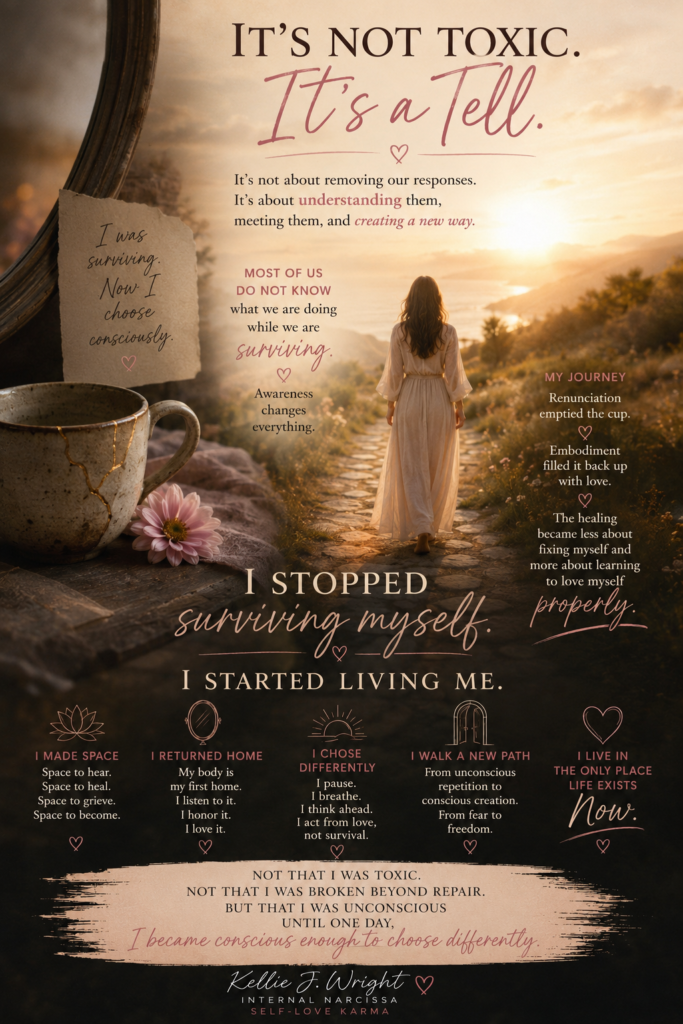
Most of us do not know what we are doing while we are surviving.
I always say, “If you know better, you’ve got to do better.” But many of the decisions I made earlier in life came from a place where I genuinely could not see myself clearly. I could not see the nervous system patterns underneath my choices. I could not see the stress responses driving my behaviors, attachments, reactions, avoidance, or impulsivity.
I only knew I deeply wanted to be good.
I wanted to be loved.
I wanted to feel alive.
I wanted to enjoy life.
But all of that was attached to a stress response that created some of the hardest coping mechanisms imaginable — fear, dissociation, intensity, emotional escape, work-hard/play-hard living, relational looping, and nervous system exhaustion.
I was living fast because I did not know how to slow down safely.
And this is the part we rarely talk about honestly as human beings:
Sometimes what we call “toxic” is actually a tell.
A signal.
A nervous system adaptation.
A learned survival strategy repeating itself long after the danger has passed.
That does not remove accountability.
It does not excuse harmful behavior.
But it changes the orientation from shame to awareness.
Instead of asking:
“What is wrong with me?”
We begin asking:
“What is this response trying to protect?”
“What did my body learn?”
“What am I unconsciously recreating?”
“What future am I anticipating based on my past?”
That was the real work.
Not performing healing.
Not talking about healing.
Actually retraining myself in real time.
And it was incredibly difficult.
Because when I was younger and living inside my stress responses, I never thought about tomorrow. I never thought about how a decision would affect me later that evening, the next morning, or the next year.
It wasn’t because I didn’t want to.
It was because I truly did not know how.
I did not know how to regulate my nervous system long enough to pause between impulse and action.
I did not know how to stay with myself long enough to feel.
I did not know how to tolerate stillness.
I did not know how to remain embodied.
The greatest gift of healing has been consciousness.
The ability to pause and make decisions for my highest good instead of my lower nature.
The ability to think ahead.
The ability to stay present.
The ability to choose differently.
And one of the most sacred parts of this journey became my celibacy path.
What I eventually realized was that celibacy became both a celebratory and renunciatory path at the same time. It was not punishment. It was not fear. It was not repression.
It became space.
Space to hear myself.
Space to regulate.
Space to heal.
Space to grieve.
Space to reflect.
Space to reclaim my relationship with my body, my spirit, my nervous system, my choices, and my worth.
There were lonely moments in it.
There were painful moments in it.
There were moments of longing.
But there was also peace.
Clarity.
Self-respect.
Freedom.
Devotion.
Integrity.
Embodiment.
For the first time in my life, I began meeting myself without distraction.
And then, somewhere along the journey, the path changed again.
Years later, what began as renunciation slowly became celebration.
Not celebration in the performative sense, but in the deeply embodied sense — gratitude for being alive, gratitude for consciousness, gratitude for the body, for breath, for peace, for love, for God, for presence, for the ability to finally participate in my own life consciously instead of surviving it unconsciously.
The renunciation emptied the cup.
The embodiment filled it back up with love.
And eventually, the healing became less about fixing myself and more about learning how to love myself properly.
That is where embodiment truly began for me.
Making peace with my past.
Falling in love with my body.
Understanding that my body is not an object for performance or punishment.
It is my home.
My first home.
Learning to care for my body lovingly has become one of the most profound daily practices of my life.
I talk to my body now.
I ask it what it needs.
I thank it.
I nourish it.
I rest it.
I listen to it.
I no longer want to manhandle it through unrealistic beauty standards or expectations that were never truly mine to begin with.
This is my body.
My life.
My path.
My experience.
And my body is my gift to live in.
To breathe in.
To experience life through.
It is a masterpiece.
We all are.
That’s the joy of it.
And maybe that is the real confession:
Not that I was toxic.
Not that I was broken beyond repair.
But that I was unconscious of the nervous system patterns running my life.
Until one day, I became conscious enough to choose differently.
And once you truly retrain yourself with love, awareness, embodiment, and practice, something extraordinary begins to happen:
You stop surviving yourself.
You stop abandoning yourself.
You stop running from yourself.
And for the first time, you become free enough to live in the only place life has ever existed:
Now.
In Love & Light,
Kellie J. Wright
Internal Narcissa
Self-love Karma